

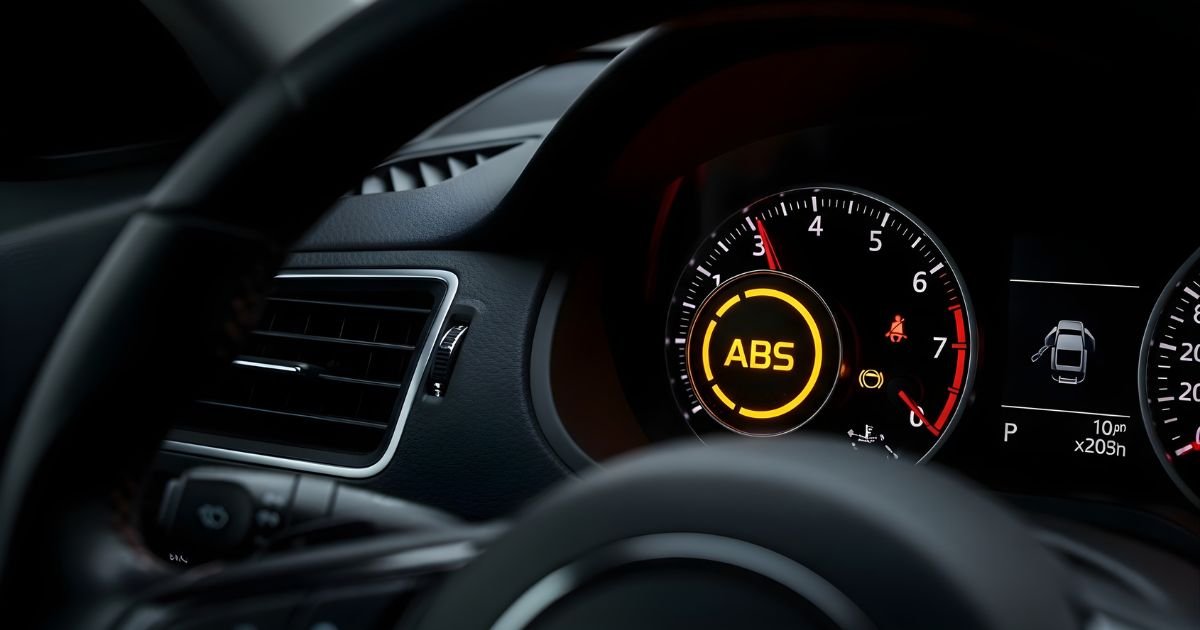
ABS stands for Anti-lock Braking System. It prevents a car’s wheels from locking during hard braking by automatically pulsing the brakes, helping the driver maintain steering control and stability. It reduces skidding but does not always shorten stopping distance.
Anti-Lock Braking System (ABS), quite arguably the most crucial automotive safety feature, is something that many drivers are not fully aware of what it does and how it works. If you’ve ever been curious about what the ABS light on your dashboard is trying to tell you or, for that matter, why your brake pedal pulses away under hard braking you’re in the right place.
In this guide, we’ll cover absolutely everything you need to know about ABS, including what it is, how it works, and why it’s a vital part of keeping riders like us safe! If you’re a newcomer on the road or just have an interest in your car’s tech, knowing ABS will make you a better and safer driver.
What Does ABS Mean on a Car?
ABS is short for Anti-Lock Braking System, which is an important safety feature that helps you maintain control of your vehicle when braking heavily.
When your wheels lock up, they no longer lose or gain traction; rather, they come to a complete stop, which causes you to slide in an uncontrolled manner across the road. This will lock your steering and transform a dangerous situation into a potentially lethal one.
The anti-lock braking system (ABS) does this by pumping your brakes—up to 15 times a second—to keep traction between your tires and the road. This pulsing action ensures your wheels continue to turn, even when you are braking as hard as possible, which helps to maintain control of your steering.
Imagine it as an extremely advanced version of the old trick where drivers were taught to pump their brakes themselves when they had to stop in a hurry. But ABS do this much more quickly and efficiently than any human can, effectively making split-second corrections that may make the difference between a hard stop and a collision.
How Does ABS Work in Your Vehicle?
Understanding how ABS functions help you appreciate why it’s such a revolutionary safety technology. The system consists of four main components working together seamlessly: wheel speed sensors, hydraulic valves, a pump, and an electronic control unit (ECU).
The Wheel Speed Sensors
Each wheel on your vehicle has a speed sensor that constantly monitors how fast that wheel is rotating. These sensors send real-time data to the ABS control module, typically measuring wheel speed dozens of times per second. The moment a sensor detects that a wheel is about to lock up meaning it’s decelerating much faster than the others—it triggers the ABS system into action.
The Hydraulic Control Unit
When the system detects an impending wheel lock, hydraulic valves in the brake lines open and close rapidly. This controls the amount of brake fluid pressure reaching each wheel’s brake caliper. By modulating this pressure, the system can release and reapply braking force multiple times per second, preventing the wheel from stopping completely while still maintaining maximum braking efficiency.
The Electronic Brain
The ABS control module is the brain of the operation. It processes information from all wheel speed sensors simultaneously, calculates the optimal braking force for each wheel, and commands the hydraulic valves to adjust accordingly. This happens so quickly that the entire process feels nearly instantaneous to the driver—you simply experience a pulsing sensation in the brake pedal and hear a rapid grinding or buzzing sound.

What Does ABS Mean on a Car Dashboard?
When that ABS warning light pops up on your dashboard, it’s your car’s way of telling you it sees a problem with the anti-lock braking system. This light usually appears in the form of “ABS” inside a circle, sometimes with brackets around each side. What this alert is telling you and what to do in its wake is important.
While driving, the ABS light is supposed to come on at startup as a bulb check for a second or two, but then go out. If it stays on after a few seconds or comes on while you’re driving, the system is malfunctioning somewhere.
Common causes include defective wheel speed sensors, low brake fluid, broken wiring, or a faulty ABS control module.
Here’s what you need to know: If the ABS light is on, your regular brakes should work fine, but the anti-lock feature won’t. Which is to say: Your wheels can lock up during hard braking, leading potentially to a loss of steering control. You can still use the vehicle in the meantime, but get it checked out by an experienced mechanic straight away. Ignore this warning at your peril — it’s designed to protect you.
The Key Benefits of Anti-Lock Braking Systems
Enhanced Steering Control During Emergency Stops
The primary advantage of ABS is maintaining steering control when you need it most. In a panic braking situation without ABS, locked wheels cause your car to slide straight ahead regardless of where you turn the steering wheel.
With ABS, you can brake hard and still steer around obstacles—a capability that has prevented countless accidents. This is particularly crucial on wet, icy, or loose surfaces where traction is already compromised.
Reduced Stopping Distances on Most Surfaces
On dry pavement and most road surfaces, ABS typically reduces stopping distances compared to locked-wheel braking. The system optimizes the friction between your tires and the road, keeping you in that sweet spot just before the wheels would lock. Studies have shown that ABS can reduce stopping distances by 10-30% depending on road conditions and vehicle type.
Improved Vehicle Stability
ABS helps prevent dangerous spin-outs and loss of vehicle control. When wheels lock unevenly—say, the rear wheels lock before the front—vehicles can spin out of control. The anti-lock braking system prevents this by ensuring all wheels maintain traction and rotate at appropriate speeds relative to each other, keeping your vehicle stable and pointing in the intended direction.
Driver Confidence and Safety
Knowing your vehicle has ABS gives you confidence to brake firmly in emergencies without fear of losing control. Many accidents occur because drivers are afraid to brake hard enough, or they make steering mistakes during panic stops. ABS removes much of this uncertainty, allowing drivers to focus on avoiding obstacles rather than managing brake modulation.
Different Types of ABS Configurations
Four-Channel, Four-Sensor ABS
This is the most advanced and effective configuration, found in most modern vehicles. Each wheel has its own speed sensor and control valve, allowing the system to modulate brake pressure independently at all four corners. This provides optimal control and stability in all braking scenarios, whether you’re braking straight ahead or while cornering.
Three-Channel, Three-Sensor ABS
Common in trucks and SUVs, this setup has individual sensors and valves for each front wheel but only one sensor and valve for both rear wheels. While the front wheels get individual control, the rear wheels are controlled together. This is slightly less sophisticated but still highly effective and more cost-efficient for larger vehicles.
Two-Channel, Four-Sensor ABS
Some vehicles use four sensors but only two control valves—one for both front wheels and one for both rear wheels. This configuration is less common today but was popular in earlier ABS implementations as a cost-saving measure while still providing significant safety benefits.
Maintaining Your ABS: What You Need to Know
Keeping your anti-lock braking system in top condition doesn’t require extensive maintenance, but there are several things you should monitor regularly. The most important is maintaining proper brake fluid levels and quality.
Brake fluid is hygroscopic, meaning it absorbs moisture over time, which can corrode ABS components and reduce system effectiveness. Most manufacturers recommend changing brake fluid every two to three years, though you should consult your owner’s manual for specific intervals.
How to Use ABS Effectively in Emergency Situations
When the situation calls for emergency braking, your natural reaction is key. The right way to use ABS is simple, but it’s not what drivers who learned on older cars are expecting. Press the brake pedal as hard as you can and hold it—don’t pump or release pressure. At the same time, you need to steer around the obstruction or towards your desired direction’s location.
You should feel a strong pulsing through the brake pedal, and you may hear grinding or buzzing noises. This is fine and is a sign of the system cycling quite quickly to avoid wheel lock. Don’t allow this feeling to prompt you to release the brakes. When they start to sense it, a lot of drivers naturally back off, but there shouldn’t be hesitation: To get the best out of this system, drivers need to keep very consistent pressure with no variation in force.
Practice makes perfect. If feasible, locate an empty parking lot and practice making emergency stops so you understand how your ABS feels and sounds when engaged. This mastered exposure will bring targeted results during a critical situation to enable you to respond at your best when it counts.
Final Thought
Understanding what ABS means on a car goes beyond just knowing the acronym—it’s about appreciating a technology that has saved countless lives and prevented innumerable accidents. The anti-lock braking system represents one of the most significant automotive safety advances of the past fifty years, transforming how vehicles handle emergency braking situations.
By preventing wheel lock and maintaining steering control during hard braking, ABS gives you capabilities that would be impossible in older vehicles.
Whether you’re a new driver learning the fundamentals or an experienced motorist wanting to maximize your vehicle’s safety features, knowing how to properly use your ABS can make the crucial difference in an emergency.
Remember: brake hard, hold firm pressure, and steer to safety. Don’t pump the brakes, don’t ease off when you feel pulsing, and never ignore your ABS warning light if it illuminates.
