

Back in the days when phones were just for calling folks? Those days are long gone. Our modern smartphones, increasingly powerful pocket-sized computers, have revolutionized how we live, work, and interact with the world. If you’ve ever sought a clear accounting of why these gadgets are so essential, you’re not alone.
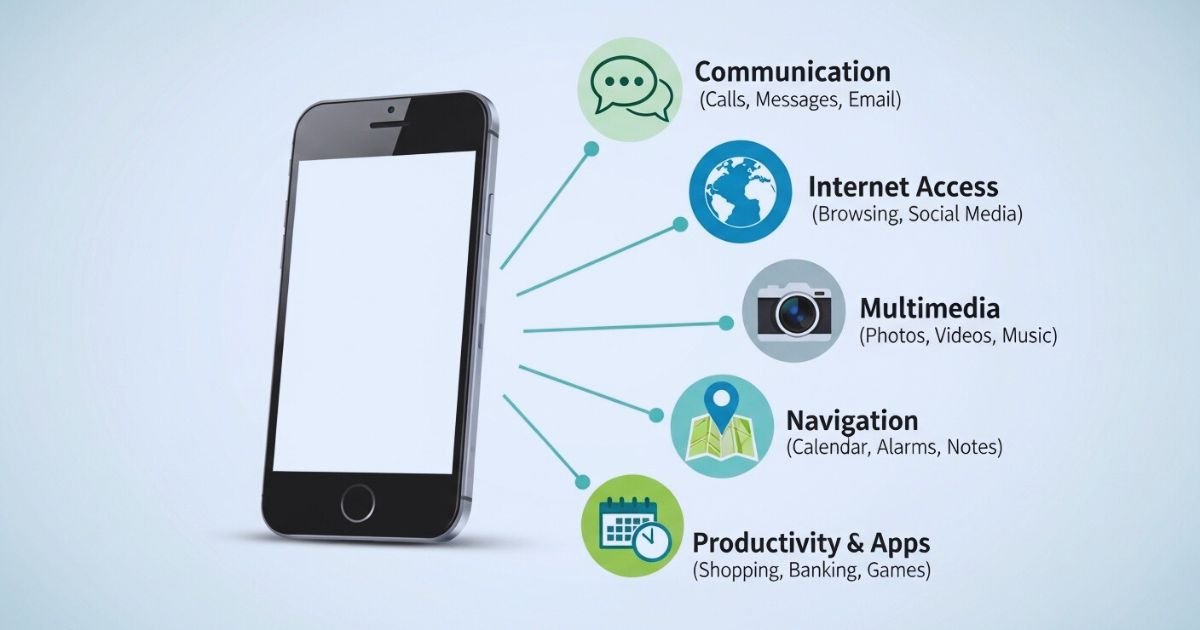
Recognizing what the primary functions of a phone are helps us understand why we pick up these gadgets dozens of times per day. From simple communication to sweeping the internet, modern phones are our cameras, bank accounts, gaming consoles, and personal assistants—a single device that has replaced countless others.
In this exhaustive handbook, we’ll take a look at some of the central processes that make phones indispensable and how you can get hold of those functions to put them to good use – as well as how these devices are developing further in response to our shifting requirements … in an ever more connected world.

The Communication Core: Staying Connected Across Distances
Voice Calls and Video Conferencing
At its heart, a phone’s primary purpose remains communication, though it’s evolved far beyond simple voice calls. Modern smartphones deliver crystal-clear conversations through advanced audio processing and noise cancellation technology. You can now seamlessly switch between traditional cellular calls, internet-based voice calls through apps like WhatsApp or Telegram, and high-definition video calls that make face-to-face conversations possible regardless of distance.
Key communication features include:
- Traditional cellular voice calls with HD audio
- VoIP calling through internet connection
- Group video conferences supporting multiple participants
- Screen sharing during calls for presentations
- Call recording and voicemail transcription
- Emergency calling with location services
Text Messaging and Instant Communication
Texting has become more nuanced and easier. All from your phone that serves as the hub of those rich multimedia conversations, through messaging apps. These applications offer group chats, voice notes, photo sharing, location sharing, and even “self-destructing” messages for privacy-focused users.
What’s so powerful about contemporary messaging is its breadth. You can send a quick text, share your live location with friends meeting you for dinner, throw out poll questions in group chats and send voice notes when typing seems too laborious.
The software, known as messaging apps have also become digital hang outs where conversations flow back and forth ever so naturally, turning into everlasting dialogues that help build personal or professional relationships.
Internet Access and Information Gateway
One of the most transformative functions of modern phones is providing constant internet access. Your device serves as a portal to virtually unlimited information, putting the world’s knowledge literally at your fingertips. Web browsing on phones has evolved to rival desktop experiences, with responsive websites and powerful mobile browsers that handle complex web applications effortlessly.
This connectivity fundamentally changes how we navigate daily life. Lost in an unfamiliar neighborhood? Your phone provides instant directions. Curious about a historical fact during dinner conversation? Look it up immediately.
Need to research a product before purchasing? Read reviews, compare prices, and make informed decisions on the spot. The ability to access information instantly has made us more informed consumers, better-informed citizens, and more capable problem-solvers.
Photography and Videography Hub
Capturing Life’s Moments
You know what the main features of a phone are and how to keep up with those, but what about using it as the cutting-edge camera system that you have in hand right now?
It’s done using what’s known as computational photography, something that has become commonplace on today’s smartphones. The creative flexibility once available only to professional photographers is built into the camera, with wide-angle, telephoto, and ultra-wide options in multiple lens systems.
Megapixels aren’t everything to your phone’s camera anymore. AI beautify anytime: a real-time beauty effect that allows you to take your perfect selfie across any light conditions; flattering filters ideal for taking selfies.
Night mode takes clear and detailed images even in near darkness, portrait mode brings professional studio quality depth of field to your mobile photography while HDR technology produces clearer photos by adjusting the contrast of different areas of the photo.
Photography capabilities include:
- Multi-lens camera systems for versatile shooting
- AI-powered scene recognition and optimization
- 4K and even 8K video recording
- Slow-motion and time-lapse video modes
- Professional editing tools built into the camera app
- Instant sharing to social media or cloud storage
Creative Content Creation
Beyond simple snapshots, phones have become complete content creation studios. You can shoot, edit, and publish professional-quality videos entirely on your device. Built-in editing tools offer filters, transitions, color grading, and audio mixing capabilities that previously required expensive software and powerful computers.
This democratization of content creation has fueled the creator economy. Vloggers, influencers, educators, and artists use phones as their primary production tools, proving that compelling content depends more on creativity than equipment budgets. Your phone enables you to tell visual stories, document experiences, and express yourself creatively with minimal barriers to entry.
Entertainment and Media Consumption
Your phone functions as a comprehensive entertainment center that fits in your pocket. Streaming services deliver unlimited music, podcasts, movies, and TV shows on demand. Whether you’re commuting, exercising, or relaxing at home, your device provides personalized entertainment tailored to your preferences.
Gaming has evolved into a major phone function, with mobile games ranging from casual puzzles to graphically intensive titles that rival console experiences. Social media platforms offer endless scrolling entertainment, while YouTube and similar services provide educational content, tutorials, music videos, and user-generated entertainment.
Productivity and Organization Tools
Task Management and Scheduling
When considering what are the main functions of a phone, its role as a productivity powerhouse deserves serious attention. Your device serves as a digital command center for managing your life. Calendar apps sync across devices, ensuring you never miss appointments or deadlines. Task management applications help you organize projects, set reminders, and track progress toward goals.
The integration between productivity apps creates powerful workflows. You can receive a meeting invitation via email, add it to your calendar with one tap, set a location-based reminder to leave on time, and access relevant documents during the meeting—all seamlessly coordinated through your phone.
Productivity features include:
- Synchronized calendars with smart notifications
- Note-taking apps with voice transcription
- Document creation and editing capabilities
- Cloud storage access for files anywhere
- Email management across multiple accounts
- Time-tracking and focus timer applications
Professional Communication and Collaboration
Phones have blurred the lines between personal and professional life by enabling work from anywhere. Business communication apps like Slack, Microsoft Teams, and Zoom keep you connected to colleagues regardless of location. You can participate in virtual meetings, share files, collaborate on documents in real-time, and manage projects through dedicated applications.
This mobile productivity extends to specialized professional tools. Designers use phones for quick mockups, photographers for on-location editing, salespeople for CRM access, and entrepreneurs for managing business operations.
The ability to respond quickly to professional demands—reviewing a contract during lunch, approving a purchase order while traveling, or joining an emergency video call from home—has fundamentally changed workplace flexibility and expectations.
Navigation and Location Services
GPS functionality has made getting lost nearly obsolete. Your phone provides turn-by-turn navigation whether you’re driving, walking, cycling, or using public transportation. Real-time traffic updates automatically reroute you around congestion, while integrated transit information shows bus and train schedules with impressive accuracy.
Location services extend beyond basic navigation. They enable location-based reminders (get an alert when you arrive at the grocery store), help you find nearby restaurants or gas stations, track fitness activities with detailed route mapping, and even help locate your parked car. Safety features like emergency location sharing and Find My Phone services provide peace of mind, while geotagging adds context to photos and social media posts.
Mobile Payment and Digital Wallet
Modern-day phones’ financial capabilities are a game-changer in the way we manage money. Be it credit cards, debit cards, membership cards, or boarding passes, even forms of id – digital wallets can hold them all. With contactless payment technology, you can make transactions by tapping your phone at checkout rather than swiping a card—a faster, more secure method of payment.
Brick-and-mortar banks can give you full-service account management on your phone. And manage all your accounts in one place, pay bills, and categorize expenses e through easy–to-use interfaces.
Peer-to-peer payment apps continue to make it easy for friends to split the restaurant bill or send money to one another. The elevated capabilities of cryptocurrency wallets mean that people can even invest in digital currency markets, proving that the phone keeps on taking over for tools or institutions.
Health and Fitness Tracking
Smartphones have become personal health assistants through built-in sensors and dedicated applications. Accelerometers and gyroscopes track your steps, distance traveled, and activity levels throughout the day. Heart rate sensors monitor cardiovascular health, while some phones even measure blood oxygen levels and detect irregular heart rhythms.
Fitness apps leverage this sensor data to provide comprehensive health insights. Track workouts, log nutrition, monitor sleep patterns, and receive personalized recommendations for improving wellness. Integration with wearable devices extends these capabilities further, creating a complete health monitoring ecosystem.
Meditation apps support mental health, period-tracking apps help with reproductive health awareness, and medication reminder apps ensure adherence to treatment plans. Your phone essentially functions as a wellness coach that’s always available and increasingly intelligent about understanding your health patterns.
Security and Privacy Management
Modern phones incorporate sophisticated security features that protect your personal information. Biometric authentication—fingerprint sensors and facial recognition—provides convenient yet secure device access. Encryption protects stored data and communications, while app permissions give you granular control over what information applications can access.
Security extends to practical safety features. Emergency SOS functions can quickly alert authorities and designated contacts with your location. Two-factor authentication apps add extra protection to online accounts. Password managers securely store login credentials, generating and remembering complex passwords so you don’t have to.
Find My Phone features help locate lost devices, remotely lock them, or erase data if recovery seems unlikely. Privacy-focused features like VPN support, tracker blocking, and privacy reports show which apps access your data, empowering you to make informed decisions about digital privacy.
Final Thought
Understanding what are the main functions of a phone reveals why these devices have become extensions of ourselves. From fundamental communication to advanced productivity, creative expression to health management, phones consolidate countless tools into one versatile device. They keep us connected to loved ones, informed about the world, productive in our work, and entertained during downtime.
The remarkable aspect of phone evolution is that new functions continue emerging through software updates and innovative applications. What started as devices for making calls have become indispensable life management tools that adapt to our individual needs and preferences.
