

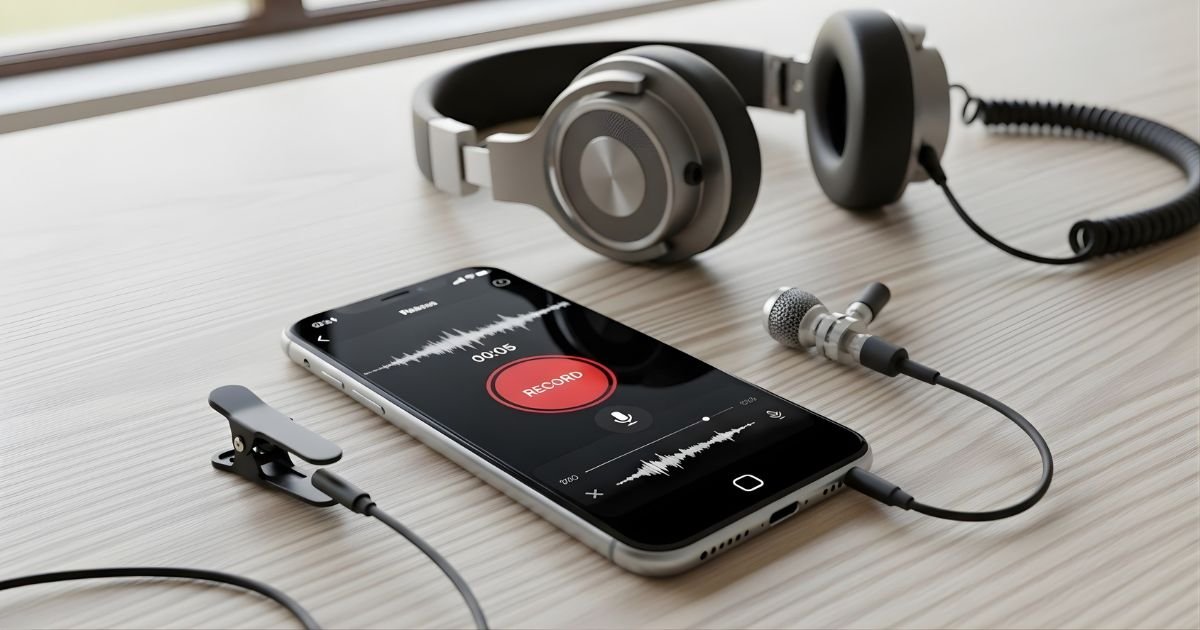
Have you ever wanted to jot down the audio as perfectism in a meeting, lecture, or creative moment? Whether you are someone who needs to record lectures at school, conduct interviews for a project, or just have a way to remember your grocery list when you pull out your phone in the car, learning how do I record audio on my phone is ostensibly important in an increasingly digital world. Open your phone’s built-in recording app, tap the record button, and keep the phone about 5–6 inches from your mouth or use an external mic for better audio quality.
You already have a robust recording device in your pocket — one that the vast majority of people don’t know how to use to its full potential. The good news? You don’t have to spend much or know too much to sound like a pro.
In this beginner-level how-to, I’ll explain all the ways you can record audio on your phone, including using built-in apps and tweaking your system settings for clear sound pickup. Time to turn your mobile phone into a trusty recording tool!
How to Record High-Quality Audio Using Your Phone
Before you start thinking about third-party apps or fancy equipment, check out what your phone can do first. On both iPhones and Android phones, something as simple as the built-in mics on these devices can grab surprisingly good audio recordings in a pinch.
Most Current smartphones offer several microphones well-positioned to reduce background noise and provide enhanced voice clarity. They’re not the tinnies you may recall from old flip phones but are designed to record as wide a frequency range as possible, so they can be used for anything from casual voice memos right up to semi-pro recordings.
Of course, your phone’s stock recording app was perfectly functional to begin with, but as is often the case, third-party developers have managed to improve on that. Recordings are also saved to the cloud and can be accessed from all your devices.
Understanding these functions makes you realise that you probably already have everything you need to get going and be recording decent-sounding audio right now, without downloading a single thing or spending any money.
How Do I Record Audio on My Phone: iPhone Users
Using the Voice Memos App
For iPhone users, the Voice Memos app is your go-to solution for audio recording. This pre-installed application offers a clean, intuitive interface that makes recording as simple as pressing a button. Here’s your step-by-step guide for how do I record audio on my
Step 1: Locate the Voice Memos app on your iPhone. It typically features a red and white waveform icon. If you can’t find it, swipe down on your home screen and use Spotlight search.
Step 2: Open the app and you’ll see a large red record button at the bottom center of the screen. Tap this button to begin recording immediately.
Step 3: While recording, you’ll see a waveform visualization showing your audio levels. Speak clearly toward the bottom of your phone where the primary microphone is located.
Step 4: To pause your recording, tap the red waveform display at the top. To resume, tap the red record button again.
Step 5: When finished, tap “Done” in the bottom right corner. You’ll be prompted to name your recording—choose something descriptive so you can find it later.
Step 6: Your recording is automatically saved and can be found in the Voice Memos library, organized by date with the most recent at the top.
Advanced iPhone Recording Features
The Voice Memos app is hiding some advanced features in plain sight. And you can trim recordings right in the app, too — tap the three-dot menu icon and choose “Edit Recording,” then drag the yellow handles to clip away unwanted material.
When you choose “Enhance Recording”, computational audio will reduce background noise and increase clarity on recordings, especially useful for use cases like recordings in a busy environment. You can also overwrite parts of previous recordings if you feel you made a mistake, too, instead of having to start from scratch.
How Do I Record Audio on My Phone: Android Users
Using Google Recorder or Samsung Voice Recorder
Android’s recording experience varies slightly depending on your device manufacturer, but the process remains straightforward. Google Pixel phones come with the exceptional Recorder app, while Samsung devices feature Voice Recorder. Other Android phones typically include a generic sound recorder app.
Step 1: Find your recording app. On Google Pixels, look for “Recorder.” On Samsung devices, search for “Voice Recorder” in your app drawer or Samsung folder.
Step 2: Open the app and tap the large record button, usually positioned prominently at the bottom or center of the screen.
Step 3: During recording, you’ll see real-time waveforms and, on Google Recorder, automatic transcription appearing as you speak.
Step 4: Pause or stop the recording using the on-screen controls. Most apps use a pause button (two vertical bars) and a stop button (square icon).
Step 5: Save and name your recording. Android apps typically auto-save, but you can rename files by tapping on them and selecting the rename or edit option.
Step 6: Access your recordings from the app’s library, where they’re organized chronologically with options to search, share, or delete.
Special Features for Android Recording
Google’s Recorder app deserves special mention for its AI-powered transcription feature, which converts speech to text in real-time—absolutely free and without requiring an internet connection.
This makes it invaluable for interviews, lectures, or any situation where you need both audio and written records. Samsung’s Voice Recorder offers interview mode, which optimizes recording for multiple speakers, and a speech-to-text conversion feature for many languages. These built-in capabilities often rival or exceed what paid third-party apps offer.
Optimizing Your Phone’s Audio Recording Settings
But producing clear, professional-quality recordings doesn’t come down to a race — it’s an exercise in setting up your space for the best possible end results. The vast majority of recording apps have quality settings, which trade file size for audio fidelity.
If it’s an important recording, such as interviews or musical performances, always go for the highest quality you can find or set for, usually named “Lossless,” “High Quality,” or witha particular bitrate like 256 kbps and above. Although these make larger files, storage is cheap — and you can’t increase quality later.
Think about your recording format, too. WAV and FLAC files retain more of the audio data than compressed formats such as MP3 or AAC, but they may require more storage space. For voice recordings that do not require much of a file size, compressed formats are ideal, such as MP3 (like we used in our example above) at 128Kbps or higher.
There are now many apps that can do automatic noise reduction and enhancement -trial them on recordings made before your real session, as they may introduce unwanted artifacts: they could make people’s voices sound “processed” or unnatural.
Essential Techniques for Crystal-Clear Phone Recordings
Positioning and Distance
The physical relationship between your phone and the audio source dramatically impacts recording quality. Position your phone’s microphone approximately 6-12 inches from the speaker’s mouth for optimal voice capture.
Too close creates distortion and plosive sounds (those harsh “p” and “b” sounds), while too far introduces excessive room echo and background noise. If recording multiple people, place the phone equidistant between speakers, or consider recording multiple takes with the phone repositioned closer to each person.
Avoid holding the phone during recording if possible. Even gentle handling creates rumbling sounds that microphones capture as distracting noise. Instead, place your phone on a stable surface, propped against something soft to minimize vibration transfer. If you must hold it, grip gently near the top, away from the microphone ports, and keep your hands as still as possible throughout the recording session.
Controlling Your Recording Environment
Your environment matters just as much as your technique when learning how do I record audio on my phone effectively. Small, hard-surfaced rooms create echoes that muddy your recordings, while larger spaces with soft furnishings absorb sound reflections, resulting in clearer, more professional audio.
If you’re stuck with a less-than-ideal space, simple modifications make surprising differences. Close windows to reduce traffic noise, turn off air conditioning or fans that create constant hum, and silence notification sounds on all nearby devices.
Consider the time of day for your recordings as well. Early mornings and late evenings typically offer quieter ambient conditions than midday when activity peaks. If recording outdoors, shield your phone from wind, which creates overwhelming noise that post-processing can’t fix.
Even a gentle breeze directly hitting the microphone ruins otherwise perfect recordings. Position your body to block wind, or create a simple windscreen using foam or even your hand cupped around (but not touching) the microphone.
When to Use Third-Party Recording Apps
While native apps perform just fine for most needs, there are third-party apps that specialize in advanced recording features for distinct use cases. Apps such as Rev Voice Recorder offer professional-level transcription services, and Dolby On uses advanced audio processing to better music recordings.
Ferrite Recording Studio provides multitrack editing on your phone, and Voice Record Pro has flexible file format exports for professional workflows.
It’s not a matter of third-party apps being “better” than the built-in version; it’s about whether their features in particular happen to mesh well with your own needs. If you’re capturing informal voice memos, interviews or lectures, your phone’s built-in app ought to have all the features you need.
But if you require more complicated editing, professional transcription services, specific audio types, or features such as scheduled recording and cloud storage that go beyond the capabilities of your built-in app, then there’s sense in exploring specific apps for podcasts.
Managing and Organizing Your Audio Recordings
It allows you to keep recordings in order and easily send them to the cloud, which was crucial for us (not wanting someone to have to “scroll” through 100’s of files trying to find the one we needed from a few weeks ago. If you don’t have a naming convention now, establish one as soon as possible—and put date,d subjects, and participants into your file names.
Instead of “Recording 047”, they could have simply described the recording as “2026-01-26_Client-Meeting_Johnso,n” and I would be on instant recognition. Most apps let you edit file names after the fact, and the time spent in these few seconds of organization will save many minutes or more of searching for something later.
Use the organizational tools embedded in your phone. Use folders or categories in your recording app to keep work recordings separate from personal notes, interviews distinct from lectures, and musical ideas apart from podcasts.
Get into the habit of exporting your most precious recordings to cloud service providers like Google Drive, Dropbox, or iCloud — for backup and phone storage space. 3. Keep the original. Both preserve your raw data and keep a polished version at hand for sharingwith people.
Troubleshooting Common Phone Recording Problems
Addressing Low Volume Issues
If your recordings consistently sound too quiet, check that your microphone isn’t covered by a case or your hand during recording. Many phone cases, particularly rugged protective ones, partially obstruct microphone ports.
Speaking too far from the microphone forces you to increase playback volume, which amplifies both voice and background noise proportionally. Move closer to the source, and if your app offers input level controls, adjust these before recording rather than boosting volume during playback.
Eliminating Background Noise and Echo
Background noise problems usually stem from environment rather than equipment. Record in smaller, furnished rooms rather than large, empty spaces. Closets full of hanging clothes make surprisingly effective recording booths because fabric absorbs sound reflections.
If persistent humming appears in recordings, identify and eliminate the source—refrigerators, computers, and air conditioning systems are common culprits. For echo reduction, position yourself closer to soft surfaces like curtains, carpets, or upholstered furniture that dampen sound reflections.
Legal Considerations When Recording Audio
To record any conversation involving other people, become familiar with your region’s laws on consent. Some areas are all-party consent, where everyone who is being recorded must be made aware that the recording is taking place and agree to it. Other jurisdictions have one-party consent laws, allowing the person doing the recording to be aware, but not necessarily any other party.
Never take for granted: Investigate your location’s specific needs, and when unsure, always tell a participant that you’re recording. Even without the legal obligations, ethical recording practices help to build trust and respect with the people you’re recording.
Professional contexts have additional considerations. If you want to record your work meetings, client ccallss or critical business conversations, you usually need the explicit consent of your company and participants.
Educational environments differ greatly, as some colleges expressly forbid lecture recording without instructor authorization, and other institutions do all they can to support it.
Conclusion
Knowing how to record audio on your smartphone gives you access to many worlds of the moments, ideas, and conversations that matter. You’ve realized that all along your smartphone has possessed strong recording features in its built-in apps, settings,s and methods that can turn run-of-the-mill recordings into crystal-clear, ar professional-sounding audio.
The specifics may vary depending on whether you’re using an iPhone’s Voice Memos or an Android’s Recorder app, but the fundamentals remain the same:
Think about where to place your microphone, keep control of your environment when possible, set quality optionsneeded n andded systematically, and organize your workflow. Great recordings come from not just having the right tool for the job, but knowing how to use your tools!
No matter which way you go, start with a basic (and free) native option provided by your phone in order to hone your skills and test positioning and environmental controls.
Only after doing so should you seek out third-party solutions based on the exact features they offer over what you already have. In time, you’ll develop a sense of what does and doesn’t work in recording.
