

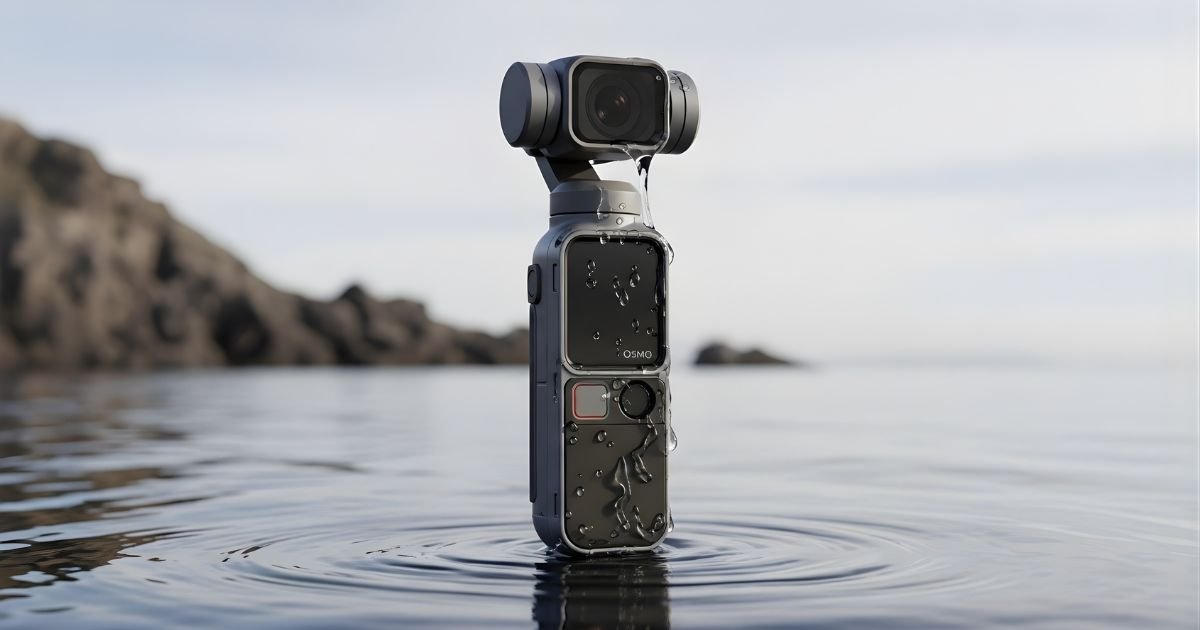
So you’re interested in the DJI Osmo Pocket 3, perhaps you own one already, and now it’s time for the big question: Does this slim little camera like water? It’s a totally reasonable question.
After all, we live in a world where satellite systems do serious work and some of life’s best moments are spent poolside, beachside, or next to the barbecue in places that don’t leave your phone close enough to Amped for it to work properly.
The simple answer is no: the Osmo Pocket 3 isn’t waterproof straight out of the box but that doesn’t mean you can’t use it near water. We’ll talk about Is the Osmo Pocket 3 Waterproof feature in this article,
What if it gets? How to protect it, and whether waterproof accessories might be a good investment for ur ccreators. At the end of the piece, you’ll know exactly how to protect your investment while still getting incredible footage.
How to Understand the Osmo Pocket 3’s Water Resistance Rating
Let’s get technical — but don’t worry, this is going to be very simple. The DJI Osmo Pocket 3 is not rated by IP (Ingress Protection), which is the industry standard for how water- and dust-resistant something is.
Products such as the iPhone 15 Pro might be able to brag about an IP68 rating (capable of surviving if submerged underwater up to a certain depth). The Osmo Pocket 3 is not certified as such.
Your Osmo Pocket 3 will be able to nudge the rain away and survive the occasional splash, but it certainly isn’t made for swimming. Think of it in the same way as your laptop: It’ll be fine with a little bit of moisture, but you wouldn’t want to pour water on it.
Though the device is more or less protected naturally anyway due to its design, it’s not as if water cannot enter sonically, through the gimbal mechanism, charging port , and speaker grills.
Waterproofing wasn’t included for a reason when you look at how the device is built. The Osmo Pocket 3 has a super advanced three-axis gimbal that needs very accurate mechanical stabilization.
What Happens If Your Osmo Pocket 3 Gets Wet?
Knowing the dangers can help you decide when and where to point your camera. If the Osmo Pocket 3 gets wet, damage will depend on how much water it’s subjected to.
Little splashes, or a brief shower, usually won’t lead to an immediate failure, but moisture can accumulate within. This can cause blurred video, problems with the touchscreen, or shaky gimbal movement. The gimbal motors are very delicate and will be noisy or fail to work.
Full immersion is another matter altogether. Water can short-circuit the electronics, ruin the battery, and cause corrosion. What’s more, even if the camera does work initially, issues can develop days or weeks later. Salt water is especially harmful.
If your Osmo Pocket 3 gets wet, power it off as soon as possible. Remove any accessories, and gently shake the excess water out, then wipe the outside dry with a soft cloth. Put it in a warm, dry spot (or with silica gel or rice) for 48 to 72 hours before turning it on. If it’s still on the fritz, get in touch with DJI support.
How to Protect Your Osmo Pocket 3 Around Water
Having established that the Osmo Pocket 3 is not naturally waterproof at all, let’s discuss how to realistically protect the fucker. You don’t need to steer clear of water entirely — you simply need to be savvy about Is the Osmo Pocket 3 Waterproof it.
DJI sells an official Waterproof Case for the Osmo Pocket 3, and it’s likely your best bet if you shoot near water fairly often. This case is fully sealed and protected while providing full access to the touchscreen and gimbal, waterproof for underwater use at certain water depths. It’s designed specifically for the device and offers a perfect fit with no impact on the camera’s impressive stabilization.
In addition to the official accessory, you can also take some practical protective steps: For shooting in light rain or mist, you can use a basic plastic rain cover, even just a clear plastic bag with the hole cut out for the lens to give you at least some coverage.
Keep a microfiber cloth in your pocket to wipe droplets from the lens after dunking — water spots will destroy even pristine shots. If you slip, your smartphone will also slide into the water, so don’t forget a wrist strap or lanyard to prevent a drop,s but remember that it can still be lethal even if submerged for a few seconds.
Preventive care is as important as protective gear. Make sure all ports and covers are firmly closed before going near water or moist places. To avoid the problem, you should dry your device, even if only slightly wet after being out and coming into contact with moisture in the air, and leaving it in a case.
The Official DJI Waterproof Case: Is It Worth It?
Certainly, for those looking to take their Osmo Pocket 3 out in inclement weather,r the official waterproof case is seriously worthy of consideration. This is not a mere protective shell — it’s a carefully engineered solution that preserves the device’s functions while increasing water resistance.
You can touch the screen of your camera through the transparent cover, access all buttons using waterproof extensions, and mount your gimbal as well. The waterproof case is good for water resistance up to about 60 meters (Your actual depth will be based on the model you use).
This makes it good not only for rain but also for actual underwater work — such as snorkeling, pool parties, or capturing underwater sports. The case keeps the same optical quality that you are used to from Osmo Pocket 3, with absolutely no loss in periphery clarity or distortion – critical for getting your professional look.
It’s an easy installation: just gently slide your Osmo Pocket 3 in, clean check the all around seals are free of dirt, rt then clamp it tightly shut. The case is bulky, of course — it will turn yopocket-sizedize gimbal into something portly.
Which is a reasonable trade-off if you’re going to be taking it into environments where the naked device would be in serious jeopardy. One good thing to remember about waterproofing is test it first with something you care about less (or just yourself) before relying on it on your actual device for the first time.
Think of it this way:
| Situation | Safe or Risky |
| Light mist | Usually safe |
| Light rain for a short time | Low risk, but not recommended |
| Heavy rain | Risky |
| Splashes from waves | Risky |
| Dropped in water | Very risky |
| Underwater filming | Not safe without case |
Alternative Waterproofing Solutions and DIY Methods
While the official waterproof case is the safest choice, third-party options exist at different prices and with different features. If you go this route, read reviews carefully and make sure the case is made specifically for the Pocket 3, not older models. Quality varies a lot, and cheaper cases can compromise protection or usability.
For quick, low-budget protection, DIY solutions like waterproof phone bags, clear pouches, or plastic wrap can help in light rain. These are only emergency fixes. They won’t protect the camera underwater and can interfere with the gimbal.
Bottom line: DIY methods are temporary and unreliable. If you often shoot around water, a proper waterproof case is a smart investment. Spending $100–150 once is far cheaper than replacing a damaged $500 camera.
Real-World Scenarios: When You Can and Can’t Use the Osmo Pocket 3
Understanding practical limitations helps you make smart decisions in the field. Let’s explore some common scenarios and whether Is the Osmo Pocket 3 Waterproof enough for each situation without additional protection.
Light rain or drizzle
Your naked Osmo Pocket 3 can probably handle this for brief periods (15-20 minutes maximum) if you’re careful. Keep it pointed downward when not actively shooting, wipe it dry frequently, and move to shelter quickly. This isn’t ideal, but it won’t necessarily destroy your device.
Heavy rain: Absolutely use the waterproof case or don’t shoot at all. Heavy rain will find every opening in your device and cause damage quickly.
Beach environments: The combination of sand, salt spray, and humidity makes beaches particularly dangerous for unprotected electronics. Even if you stay away from the water, salt air and sand particles pose significant risks. Use the waterproof case or keep your Osmo Pocket 3 securely stored.
Pool parties or water parks: Definitely require the waterproof case if you want to capture the action. Even staying poolside without protection is risky due to splashing.
Snorkeling or underwater filming: This is what the waterproof case was designed for—enjoy full underwater capabilities with proper protection.
Snow and winter conditions: Snow is essentially frozen water, and when it melts on your warm device, you’ve got moisture problems. Cold also affects battery performance. Use protection and keep extra batteries warm.
Comparing Water Resistance with Competitor Cameras
How the Osmo Pocket 3’s water situation compares to other options. The GoPro Hero 12, for example, is waterproof to 10 meters without using any kind of case — a massive asset if you want water resistance above all else. But GoPros don’t have the type of high-end gimbal stabilization that separates the Osmo Pocket 3 from the pack.
The Insta360 GO 3 is also waterproof to 5 meters without a case, so it’s more natively water-resistant than the Osmo Pocket 3. But it also has a smaller sensor and a new body style that you might not want for every task.
The Sony RX0 II offers waterproofing to 10 meters, and crushproof and shockproof too, but it costs more and lacks gimbal stabilization. The Osmo Pocket 3 compromises: You get better stabilization, excellent image quality, and a bigger touchscreen and more-compact design, but you’re givingup on-board water resistance.
This is the right trade-off for a lot of creators — waterproofing adds cost and bulk, both, and not everybody needs it often enough to justify those compromises on every device they own.
Maintaining Your Osmo Pocket 3 for Longevity
Proper maintenance extends your device’s life and keeps it performing optimally, especially if you occasionally expose it to challenging conditions. After any exposure to moisture, humidity, or dusty environments, give your Osmo Pocket 3 a thorough cleaning.
Use compressed air to remove dust from ports and crevices, wipe the lens with appropriate microfiber cloths, and ensure the gimbal moves freely without any grinding or resistance. Store your device in a cool, dry place with moderate temperatures.
Extreme heat or cold can damage the battery and internal components, while humidity promotes corrosion. Using a storage case with silica gel packets helps maintain optimal conditions.
Regularly update your firmware, as DJI sometimes includes improvements to system stability and performance that can help the device handle various conditions better. Inspect the device periodically for any signs of wear, corrosion, or damage, especially around ports and the gimbal mechanism.
Conclusion
So, is the Osmo Pocket 3 water-resistant? No, it doesn’t — but with the right protections (or accessories), water doesn’t have to be a dealbreaker. The Osmo Pocket 3 is really great at what it was meant to do: capture super-smooth high-quality footage in a small form factor.
It didn’t need to be waterproof, and that’s totally fine, because there are other DJI solutions for people who do require it. If your art and you are often near water, spend up for the official waterproof case it’s purpose-built, trustworthy equipment and value added.
If you are exposed to light moisture on occasion, simple precautions and awareness usually will be enough. Know your device’s limits, respect them, and you’ll have years of epic footage with no waterproof nightmares.
The key takeaway? I don’t want you to be water wary and miss out on some great shots, but at the same time, don’t be careless. Know when you need to protect yourself, outfit properly when it’s right, and have a backup.
