


If you’ve been building your YouTube channel and watching your subscriber count climb, you’ve probably wondered about the payoff. Here’s the truth that might surprise you: YouTube doesn’t pay you directly for subscribers.
That number next to your channel name doesn’t translate into automatic dollar signs. Instead, YouTube’s payment system revolves around ad revenue, watch time, and engagement metrics that go far beyond your subscriber count.
Understanding how much do you get paid per subscriber on YouTube requires looking at the bigger picture of monetization, including CPM rates, niche selection, and viewer engagement.
In this article, we’ll break down exactly how YouTube creators actually make money, what factors influence your earnings, and realistic income expectations based on channel size and performance.
The Subscriber Myth: Why Subscribers Don’t Equal Direct Payment
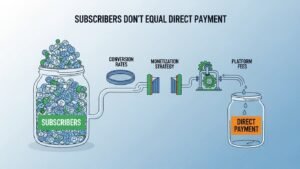
Let’s clear up the biggest misconception right away. YouTube doesn’t write you a check based on how many people hit that subscribe button. You could have 100,000 subscribers and earn less than someone with 10,000 subscribers if their content performs differently.
Subscribers matter indirectly because they’re more likely to watch your videos, which generates ad views. But here’s what actually counts: watch time, ad impressions, and viewer engagement. A subscriber who never watches your content contributes nothing to your revenue. Meanwhile, non-subscribers who regularly watch and engage with your videos through search or recommendations are worth their weight in gold.
The real value of subscribers lies in their potential to become consistent viewers. They receive notifications about your uploads, and their engagement signals to YouTube’s algorithm that your content deserves broader distribution. This increased visibility leads to more views, which finally translates into revenue.
How YouTube Actually Pays Creators
YouTube’s primary payment system works through the YouTube Partner Program (YPP). To join, you need at least 1,000 subscribers and 4,000 watch hours in the past 12 months, or 1,000 subscribers with 10 million valid public Shorts views in the last 90 days.
Once accepted, you earn money through:
- Ad revenue from display, overlay, and video ads
- YouTube Premium revenue from Premium members watching your content
- Channel memberships where subscribers pay monthly fees
- Super Chat and Super Stickers during live streams
- Shopping affiliate programs and merchandise shelf
The most significant income source for most creators is ad revenue, calculated through CPM (cost per mille or cost per thousand impressions) and RPM (revenue per mille or revenue per thousand views after YouTube’s cut).
Breaking Down CPM and RPM Rates
Understanding how much do you get paid per subscriber on YouTube means understanding CPM and RPM. These metrics determine your actual earnings per thousand views.
CPM represents what advertisers pay for 1,000 ad impressions on your videos. This varies wildly based on your niche, audience demographics, and season. Finance and technology channels might see CPMs of $20-$50, while gaming or entertainment channels might earn $2-$10.
RPM is what you actually receive after YouTube takes its 45% cut. If your CPM is $20, your RPM would be approximately $11. This is the number that matters for calculating your real income.
Average RPM by Channel Size and Niche
| Channel Type | Typical RPM Range | Notes |
| Finance/Business | $15-$40 | High-value advertisers |
| Technology/Software | $12-$30 | Corporate ad budgets |
| Health/Fitness | $8-$20 | Growing advertiser interest |
| Gaming/Entertainment | $3-$12 | Younger audience, lower CPMs |
| Lifestyle/Vlog | $4-$15 | Varies by content specificity |
The Real Earnings Formula: Views Matter Most

Here’s the practical math you need to know. If your RPM is $10, you earn $10 for every 1,000 views. A video with 100,000 views would generate approximately $1,000.
Now let’s connect this to subscribers. Imagine you have 50,000 subscribers, and typically 10% of them watch each new video you publish. That’s 5,000 views from subscribers alone. At a $10 RPM, that video earns $50 from subscriber views.
But successful videos rarely stop at subscriber views. YouTube’s algorithm promotes engaging content to non-subscribers through recommendations, search results, and suggested videos. A video might get 50,000 total views, with only 5,000 coming from your subscriber base. That same video would earn $500 total, with subscribers contributing just $50 (10%) of that revenue.
This illustrates why focusing solely on subscriber count misses the point. View velocity, click-through rates, and watch time drive your earnings far more than your subscriber number.
Realistic Income Expectations by Subscriber Count
While subscribers don’t directly equal payment, there are general patterns. These estimates assume decent engagement rates and consistent content creation in moderately profitable niches.
1,000-10,000 subscribers: Most creators at this level earn $50-$500 per month. You’re building momentum, learning what works, and your view counts are still relatively modest. Many creators supplement with affiliate marketing or sponsorships at this stage.
10,000-100,000 subscribers: This is where things get interesting. Monthly earnings typically range from $500-$5,000, though exceptional creators in high-CPM niches might earn significantly more. You’re getting enough views to generate meaningful ad revenue, and brands start noticing you for sponsorship opportunities.
100,000-1,000,000 subscribers: Welcome to full-time creator territory. Most channels here earn $5,000-$50,000 monthly from ads alone. Add sponsorships, merchandise, and other revenue streams, and some creators exceed $100,000 monthly. Your content reaches millions of viewers, and your income becomes more stable and predictable.
Over 1,000,000 subscribers: Top-tier creators often earn six to seven figures monthly. However, even at this level, earnings vary dramatically based on niche, content frequency, and monetization strategy. Some mega-creators with massive view counts earn far more from sponsorships and business ventures than from YouTube ad revenue.
Factors That Dramatically Impact Your Per-View Earnings
Several critical factors determine whether you’re at the low or high end of earning potential for your subscriber count.
Audience Geography
Viewers from the United States, Canada, United Kingdom, and Australia generate significantly higher CPMs than viewers from developing countries. A creator with 80% US traffic might earn 5-10 times more than someone with identical views from lower-CPM regions.
Video Length and Ad Placements
Videos over 8 minutes allow mid-roll ads, which can double or triple your revenue per view. A 15-minute video with multiple ad breaks earns substantially more than a 5-minute video with only pre-roll ads.
Viewer Demographics
Advertisers pay premium rates to reach specific audiences. Content appealing to business professionals aged 25-54 with purchasing power commands much higher CPMs than content targeting teenagers with limited disposable income.
Content Niche Profitability
Finance, real estate, insurance, technology, and business content attracts high-paying advertisers. Entertainment, pranks, and general vlogging typically earn less per view because advertisers in those spaces have smaller budgets.
Engagement and Watch Time
Videos that keep viewers watching earn more because viewers see more ads. YouTube also promotes high-retention content more aggressively, creating a positive feedback loop that increases views and revenue.
Beyond Ad Revenue: Multiplying Your Income Per Subscriber
Smart creators diversify their income streams, making each subscriber significantly more valuable than ad revenue alone.
Channel memberships allow loyal subscribers to pay $4.99-$24.99 monthly for exclusive perks. If just 1% of 50,000 subscribers join at $4.99, that’s an additional $2,495 monthly.
Affiliate marketing can generate substantial income. A single video promoting a high-ticket product might earn more from affiliate commissions than months of ad revenue. Tech reviewers and course creators particularly benefit from this model.
Sponsorships pay based on view counts and engagement rather than subscribers, but larger subscriber bases help negotiate better deals. Rates typically range from $10-$50 per 1,000 views for integrated sponsorships.
Digital products and services transform subscribers into customers. A creator selling online courses, coaching, or digital downloads might earn $50-$200 per customer, making each engaged subscriber worth far more than any single video’s ad revenue.
Maximizing Your Earnings: Strategies That Work
Understanding how much do you get paid per subscriber on YouTube is only valuable if you use that knowledge strategically.
Focus on creating highly searchable content that attracts viewers beyond your subscriber base. Tutorial videos, how-to guides, and problem-solving content continue generating views and revenue months or years after publication.
Optimize your content for higher CPM niches within your expertise. A fitness creator could shift toward nutrition science and supplement reviews instead of workout routines, potentially tripling their RPM without changing their core audience.
Increase video length strategically. If your content naturally fits 10-15 minute formats, you enable mid-roll ads without sacrificing viewer experience or retention rates.
Build a loyal community that watches immediately after upload. YouTube rewards early engagement by promoting videos more aggressively, leading to more total views and higher earnings.
Final Thoughts
So, how much do you get paid per subscriber on YouTube? The answer isn’t a fixed dollar amount because YouTube doesn’t pay per subscriber. Instead, your income depends on view counts, CPM rates, audience demographics, and engagement levels.
A subscriber might generate anywhere from $0 to $5+ annually depending on their viewing habits and your monetization strategy. The real path to YouTube income focuses on creating valuable content that attracts consistent views, optimizing for higher CPMs through niche selection and audience targeting, and diversifying revenue streams beyond ad revenue.
Your subscriber count serves as a foundation, but your earnings ultimately reflect the value you deliver to viewers and advertisers. Ready to maximize your YouTube earnings? Start by analyzing your current RPM in
YouTube Studio, identify which videos perform best financially, and create more content in those high-performing categories. Your subscribers are waiting for content that serves them while building your sustainable creator income.
