

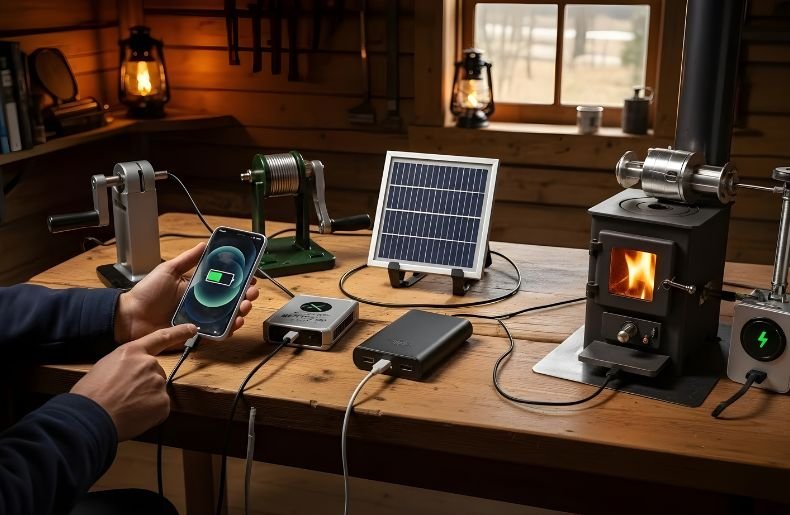
you’re on a camping trip, the power’s out after a storm, or you’re traveling through a remote area. Your phone battery is dying, and there’s no electrical outlet in sight. Knowing how to charge your phone without electricity isn’t just a neat survival trick it’s a practical skill that can keep you connected when it matters most.
Whether you’re an outdoor enthusiast, preparing for emergencies, or simply curious about alternative charging methods, understanding your options can be genuinely lifesaving.
From harnessing the sun’s energy to converting mechanical motion into power, there are numerous ways to breathe life back into your device when conventional electricity isn’t available. Let’s explore the most effective methods that actually work in real-world situations.
What Is Power Banks: Your First Line of Defense
Before diving into how do you charge your phone without electricity during an outage, let’s talk about the simplest solution: portable power banks. While technically they store electricity rather than generate it, they’re your most reliable backup when the grid goes down.
A quality power bank charged beforehand can provide multiple full charges for your smartphone, making it essential for any emergency kit. The key is preparation. Keep at least one power bank fully charged at all times, stored in an accessible location.
Modern power banks come in various capacities, measured in milliampere-hours (mAh). A 20,000mAh power bank can typically charge most smartphones four to five times. Some advanced models even feature solar panels built into their design, bridging the gap between stored and generated power.
This combination approach gives you both immediate backup power and the ability to recharge using renewable energy sources when needed.
Harnessing Solar Energy for Phone Charging
Solar power represents one of the most practical and eco-friendly methods How Do You Charge Your Phone Without Electricity from the grid. Solar chargers convert sunlight directly into electrical energy, offering a sustainable solution for outdoor adventures and emergency situations alike.
How to Use a Solar Phone Charger:
- Choose the right solar charger – Look for models with at least 10-15 watts output for efficient smartphone charging
- Position for maximum sun exposure – Place the panel directly facing the sun at a 90-degree angle
- Ensure stable placement – Secure the panel so wind won’t knock it over during charging
- Connect your device – Use the provided USB cable to link your phone to the solar panel
- Monitor the charging process – Most solar chargers have LED indicators showing power generation status
- Account for weather conditions – Cloudy days may slow charging significantly; plan accordingly
The effectiveness of solar charging depends heavily on weather conditions and panel quality. On a bright, sunny day, a good solar charger can fully power your phone in three to four hours. However, portable solar panels require direct sunlight to work efficiently, so they’re less reliable during winter months or in heavily forested areas where tree cover blocks the sun.
Hand-Crank and Pedal-Powered Chargers
When you need to charge your phone without electricity and the sun isn’t cooperating, mechanical energy becomes your ally. Hand-crank chargers and pedal generators convert your physical effort into electrical power through a simple dynamo mechanism.
Hand-crank chargers are compact devices featuring a small generator connected to a crank handle. By turning the handle continuously, you create rotational energy that’s converted into electricity. The trade-off is significant effort for modest results—typically, one minute of vigorous cranking provides about thirty seconds to one minute of talk time.
While this ratio might seem discouraging, in genuine emergencies where you need to make a critical call, these devices prove invaluable. Most hand-crank models also include built-in flashlights and AM/FM radios, making them multipurpose emergency tools rather than just phone chargers.
Bicycle-powered generators offer a more efficient mechanical charging option. These devices attach to your bicycle and use pedaling motion to generate electricity. Some models can produce enough power to charge a phone fully in about an hour of moderate cycling.
This method provides the dual benefit of exercise while generating power, making it popular among fitness enthusiasts and eco-conscious individuals. The conversion efficiency is significantly better than hand-cranking because your leg muscles can generate more sustained power output than your arms.
How Do You Charge Your Phone Without Electricity Using Your Car Battery
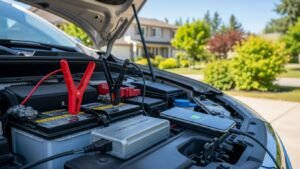
Your vehicle’s car battery provides one of the most accessible ways to charge your phone without electricity from your home. Modern cars come equipped with USB ports, but even older vehicles can charge your phone using the 12-volt cigarette lighter socket with an appropriate adapter.
Steps to Charge Using Your Car:
- Start your engine – Always run the car while charging to avoid draining the battery completely
- Locate the USB port or 12V socket – Most modern cars have USB ports; older models require a car charger adapter
- Plug in your charging cable – Use a quality car charger that matches your phone’s charging specifications
- Monitor your fuel level – Be mindful that idling consumes gas, though minimal for phone charging
- Charge efficiently – Most phones charge fully in one to two hours from a car battery
One important consideration: never charge your phone from your car battery with the engine off for extended periods unless you’re certain your battery has sufficient reserve capacity. A drained car battery could leave you stranded. For camping trips or emergency situations, consider investing in a portable jump starter with USB ports—these devices can both charge your phone and restart your car if needed.
Comparing Common Off-Grid Charging Methods
| Method | Speed | Reliability | Best Use Case |
| Solar charger | Slow | Medium | Outdoor, long outages |
| Power bank | Fast | High | Short-term backup |
| Hand crank | Very slow | Medium | Emergencies |
| Car charger | Fast | High | Travel, outages |
| DIY methods | Unstable | Low | Last resort only |
Wind-Powered and Micro-Hydro Solutions
For those in appropriate environments, wind turbines and micro-hydroelectric systems offer reliable off-grid charging solutions. Small portable wind turbines designed for camping can generate electricity whenever there’s sufficient breeze, typically requiring wind speeds of at least 10-15 mph for effective phone charging.
Micro-hydro systems work on a similar principle but use flowing water instead of wind. If you’re camping near a stream or river, placing a small water turbine in the current can provide continuous charging power throughout the day and night. These systems are particularly valuable because unlike solar panels, they can generate power 24/7 as long as water keeps flowing. The main limitation is geographical—you need access to moving water with sufficient flow rate and elevation drop to generate meaningful power.
Emergency Batteries and Alternative Power Sources
Beyond the primary methods, several creative solutions exist for how do you charge your phone without electricity in a pinch. AA battery-powered emergency chargers let you convert standard alkaline or rechargeable batteries into phone power.
These compact devices hold four to eight AA batteries and include a USB output port. While not particularly efficient or cost-effective for regular use, they’re excellent emergency backups because AA batteries are universally available and have long shelf lives.
Another intriguing option involves kinetic energy chargers that generate electricity from motion. Some backpack-mounted generators charge your devices as you walk or hike, capturing the kinetic energy from your natural movement. Though still relatively new to the consumer market, these represent an exciting direction for passive energy harvesting during outdoor activities.
Final Thoughts
Learning how to charge your phone without electricity empowers you with independence and preparedness for any situation. Whether you opt for the reliability of solar panels, the sustainability of hand-crank generators, the convenience of your car battery, or the innovation of thermoelectric devices, each method offers unique advantages suited to different circumstances.
The smartest approach combines multiple solutions—keep a charged power bank ready, invest in a quality solar charger for extended outdoor adventures, and maintain a car charger for everyday backup needs.
Start by assessing your specific needs: frequent campers benefit most from solar and mechanical options, while urban dwellers preparing for emergencies might prioritize power banks and car chargers.
Don’t wait for an emergency to test these methods—familiarize yourself with your chosen charging solutions beforehand so you’ll be confident and competent when you truly need them. Take action today by selecting at least one alternative charging method and adding it to your emergency preparedness kit. Your future self will thank you when staying connected matters most.
