

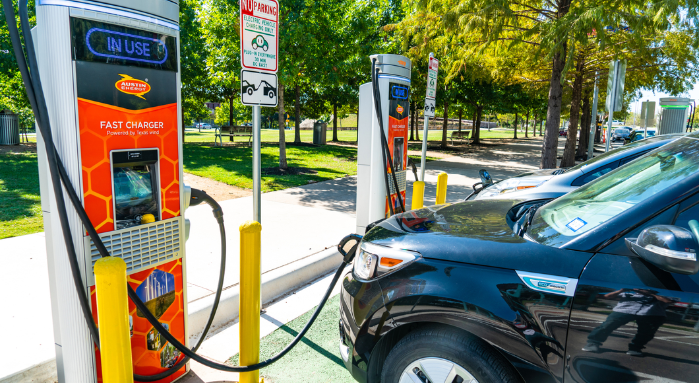
How fast are ChargePoint chargers is a common question for EV owners. Charging speed matters because it shows how long your car stays parked. It also affects how soon you can get back on the road. ChargePoint is a popular network. It offers home chargers and public chargers.
ChargePoint chargers’ speed depends on the model. Level 2 chargers deliver about 25–30 miles of range per hour. DC fast chargers are much quicker, adding up to 100–200 miles in 30 minutes, making them suitable for long-distance and quick top-ups.
You can find Level 1, Level 2, and DC fast chargers. The real speed depends on your car, the type of charger, and other conditions like battery size or temperature. This guide will explain each type of ChargePoint charger.
You will learn how long it takes to charge small, mid-range, and long-range EVs. We will also compare ChargePoint to other networks and share tips to get the best charging experience.
What are ChargePoint Chargers?
ChargePoint is one of the largest electric vehicle (EV) charging networks in the world. It provides solutions for both home and public charging. Many EV owners rely on ChargePoint chargers because they are widely available and easy to use.
You can find them in homes, workplaces, parking lots, and along highways. ChargePoint chargers vary in speed, power, and convenience, making it easier for drivers to find the right option for their car. Understanding what ChargePoint offers helps you choose the charger that fits your daily needs and long trips.
Public vs Home Charging Solutions
ChargePoint offers two main types of charging: home and public. Home chargers are designed for overnight or daily charging. They let you plug in your EV at your house and wake up to a fully charged battery. The most common home option is the ChargePoint Home Flex, which allows adjustable amperage depending on your home’s electrical setup.
Public chargers are found in offices, parking lots, shopping centers, and along highways. These include Level 2 chargers and DC fast chargers, which provide much quicker charging than home outlets. Public stations often serve multiple cars, so charging speed can vary depending on how busy the station is. The ChargePoint app helps you find the nearest charger, filter by kW output, and check real-time availability.
By understanding both home and public charging, you can plan your daily commute and longer trips with confidence. Knowing where to charge and how fast each charger works ensures you spend less time waiting and more time driving. ChargePoint’s network makes this simple, reliable, and accessible for most EV owners.
Types of ChargePoint Chargers
ChargePoint offers different chargers depending on your needs. The three main types are Level 1, Level 2, and DC fast chargers. Each one has a different power output, charging speed, and best use case. Understanding these options helps you choose the right charger for your home, workplace, or road trips.
ChargePoint Level 1 Chargers
Level 1 chargers are the simplest and slowest option. They plug into a standard 120V household outlet. The power output is usually around 1.4 kW to 1.9 kW. This adds about 3 to 5 miles of range per hour.
Level 1 charging works best for people who drive short distances daily. It is ideal for overnight charging at home if your car does not need a full recharge every day. Level 1 chargers are easy to use and don’t require special installation, but they are too slow for long trips or large EV batteries.
ChargePoint Level 2 Chargers
Level 2 chargers are the most common choice for homes and public stations. They use 240V power and offer outputs from 6.6 kW to 19.2 kW. This can add 20 to 60 miles of range per hour, depending on the car.
Level 2 chargers are faster than Level 1 and can fully charge most EVs overnight. They are ideal for daily commuting and workplace charging. Because of their speed, Level 2 chargers are widely used in offices, shopping centers, and public parking lots.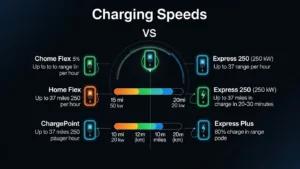
ChargePoint DC Fast Chargers
DC fast chargers are the quickest option in the ChargePoint network. They range from 50 kW to 125 kW or higher. They can charge an EV battery to 80% in 20-40 minutes, depending on the car and battery size.
These chargers are perfect for long trips or quick top-ups on the road. However, not all EVs can accept the full speed of DC fast chargers. Availability is also limited compared to Level 2 chargers, so planning is important.
How Fast Are ChargePoint Home Chargers?
Home charging is where most EV owners start. ChargePoint’s Home Flex charger is designed to make home charging simple and flexible. It plugs into your home’s electrical system and can adjust its amperage to match your setup. This allows faster charging if your home wiring can handle more power.
ChargePoint Home Flex Overview
The ChargePoint Home Flex is a Level 2 charger that works with nearly all electric vehicles. It offers power outputs from 16 amps up to 50 amps, giving you control over charging speed. The higher the amperage, the faster your EV will charge. It also has smart features like scheduling and app monitoring.
Charging Speed Based on Electrical Setup
Your home’s electrical system affects how fast the charger works. A 240V outlet with 50 amps can fully charge most EVs overnight. Lower amperage setups will take longer, but even a slower Level 2 charger is faster than a standard wall outlet (Level 1).
Real-World Charging Time Examples
- Small battery EV (like Nissan Leaf 40 kWh) → 7–8 hours
- Mid-range EV (like Tesla Model 3 Standard Range) → 9–10 hours
- Long-range EV (like Tesla Model X 100 kWh) → 12–14 hours
These times assume overnight charging at home. ChargePoint Home Flex ensures your car is ready every morning without the need to wait at public stations.
Is a Home ChargePoint Charger Fast Enough?
For most daily commuters, home-level 2 charging is more than enough. Overnight charging covers typical driving distances. The flexibility of ChargePoint Home Flex makes it suitable for larger EVs, too. It’s reliable, convenient, and gives EV owners peace of mind knowing their car is fully charged before each trip.
How Fast Are ChargePoint Public Chargers?
Public chargers let EV owners charge outside the home, at work, in shopping centers, or along highways. ChargePoint provides both Level 2 public chargers and DC fast chargers. Charging speed varies depending on the charger type, the car’s capabilities, and how busy the station is. Understanding public charging helps you plan trips and avoid long waits.
Differences Between Public Level 2 and DC Fast Chargers
Public Level 2 chargers work like home Level 2 chargers, but are often faster because they may have higher amperage. They typically add 20–30 miles of range per hour. These chargers are suitable for workplaces or shopping stops where cars are parked for a few hours.
DC fast chargers are much quicker. They can add 60–150 miles of range in 20–40 minutes, depending on the EV and charger output. These chargers are ideal for highway stops or urgent top-ups during longer trips.
Workplace vs Commercial Locations
Workplace chargers are mainly Level 2. They are convenient for employees who park all day. Commercial locations, like shopping centers or highway stations, often include DC fast chargers for quick charging.
Public chargers may be used by multiple EVs at the same time. This can reduce the charging speed slightly if the power is shared. Busy stations may require waiting, especially during peak hours.
Why Public Speeds Can Vary
Charging speed depends on several factors: the type of charger, your car’s onboard charger limit, battery size, and the current state of charge. Temperature and weather conditions can also affect how fast your EV charges.
Using the ChargePoint app can help find chargers with higher kW output and real-time availability, making public charging faster and more predictable.
How Long Does It Take to Fully Charge an EV with ChargePoint?
Knowing how long it takes to charge your EV is important for planning daily trips or longer drives. ChargePoint chargers, whether home Level 2 or public DC fast chargers, provide different speeds. The total charging time depends on your car’s battery size, the charger type, and how full the battery already is.
Charging Time Examples by Vehicle Type
- Small battery EV (e.g., Nissan Leaf 40 kWh) →
- Level 1 home charger: 12–15 hours
- Level 2 charger: 5–7 hours
- DC fast charger: 30–40 minutes (20–80%)
- Mid-range EV (e.g., Tesla Model 3 Standard Range 60 kWh) →
- Level 1 home charger: 18–20 hours
- Level 2 charger: 8–10 hours
DC fast charger: 25–35 minutes (20–80%) - Long-range EV (e.g., Tesla Model X 100 kWh) →Level 1 home charger: 30+ hours
- Level 2 charger: 12–14 hours
- DC fast charger: 40–50 minutes (20–80%)
Most fast charging happens between 20% and 80% battery. Charging slows near full to protect the battery. This means a DC fast charger fills your EV quickly to 80%, but topping up the last 20% can take longer. Understanding this helps you plan stops efficiently and avoid waiting unnecessarily.
What Affects ChargePoint Charging Speed?
ChargePoint chargers offer fast and reliable charging, but several factors can affect how quickly your EV charges. Speed depends not just on the charger, but also on your car, battery, weather, and whether you’re sharing the charger with other vehicles. Understanding these factors helps you plan charging more efficiently.
Vehicle Onboard Charger Limits
Your car’s onboard charger determines the maximum speed it can accept. Even the fastest Level 2 or DC fast charger cannot charge a car faster than its onboard limit. Some EVs handle high AC or DC power better than others. Always check your car’s specifications to know how quickly it can charge.
Battery Size and State of Charge
Larger batteries take longer to charge. A small battery EV can reach full charge faster than a long-range model. Charging also slows as the battery fills up. For example, going from 20% to 80% is faster than topping off the final 20%.
Weather and Temperature
Cold temperatures can slow charging because the battery needs to warm up. Very hot conditions may also reduce speed to protect the battery. Extreme weather can affect both Level 2 and DC fast charging.
Shared Chargers and Power Distribution
Public chargers often serve multiple cars. If several vehicles charge at the same station, the available power may be split. This can slightly reduce speed. Using the ChargePoint app to check real-time availability can help avoid crowded stations and maximize your charging speed.
ChargePoint vs Other Charging Networks
When choosing a charging network, speed and availability matter. ChargePoint is popular for home and public charging, but other networks like Tesla Superchargers, Electrify America, and EVgo offer different options. Comparing them helps you understand which network fits your needs.
ChargePoint vs Tesla Superchargers
Tesla Superchargers are among the fastest chargers on the market. They can deliver up to 250 kW, significantly faster than most ChargePoint DC fast chargers, which range from 50 kW to 125 kW. Tesla’s network focuses on long-distance travel, making it ideal for road trips. ChargePoint is slower on highways but provides more Level 2 public chargers for daily use and workplace charging.
ChargePoint vs Electrify America
Electrify America also offers high-speed DC fast chargers, up to 350 kW at select locations. It emphasizes quick highway charging. Compared to ChargePoint, Electrify America may charge faster for long-range EVs but has fewer chargers in urban areas. ChargePoint’s strength lies in widespread home and public Level 2 availability.
ChargePoint vs EVgo
EVgo focuses on urban charging and fast public stations. Its DC fast chargers are similar in speed to ChargePoint’s fast options. EVgo works well for city drivers who need short top-ups, while ChargePoint provides a broader mix of home, workplace, and public chargers, making it more flexible for daily routines.
How to Find the Fastest ChargePoint Chargers Near You
Finding a fast ChargePoint charger can save time, especially on long trips or busy days. The network includes home, workplace, and public chargers, but not all are equally fast. Using the right tools helps you locate chargers with higher kW output and fewer cars waiting.
Using the ChargePoint App
The ChargePoint app is the easiest way to find chargers. You can see nearby stations, check if they are available, and even start a charging session remotely. It shows charger type, power output, and real-time availability, helping you pick the fastest option for your EV.
Filtering and Checking Real-Time Availability
Within the app, you can filter chargers by kW output. This ensures you select Level 2 or DC fast chargers that match your car’s capabilities. Real-time status updates let you avoid crowded stations, so you spend less time waiting and more time driving. User reviews also give insights into location convenience and reliability.
Pros and Cons of ChargePoint Chargers
ChargePoint chargers are designed for convenience and flexibility. They have several advantages, but also a few limitations when it comes to charging speed. Understanding these points helps you decide if ChargePoint fits your EV needs.
| Aspect | Pros | Cons |
| Availability | Wide network of home, workplace, and public Level 2 chargers | Fewer ultra-fast DC chargers compared to Tesla or Electrify America |
| Charging Speed | Level 2 chargers provide reliable daily and overnight charging | Speed can vary at public stations if shared among multiple cars |
| Home Charging | Home Flex allows adjustable amperage for faster charging | Slower Level 1 charging takes longer for larger batteries |
| Flexibility | Supports daily commute, work, and urban charging | Not optimized solely for long-distance highway fast charging |
| Ease of Use | App shows real-time availability and location details | Some stations may require planning due to limited high-speed chargers |
Final Thoughts: How Fast Are ChargePoint Chargers Really?
ChargePoint chargers offer reliable charging for most EV owners. Level 1 chargers are slow but useful for small daily driving needs. Level 2 chargers are common and fast enough for home, work, and public use. DC fast chargers provide quick top-ups for road trips, though they are less common than Tesla or Electrify America stations.
For daily commuting, home-level 2 charging is usually sufficient. Public DC fast chargers are best for urgent charging or highway travel. ChargePoint works well for homeowners, urban drivers, and commuters who need convenient, dependable charging. Understanding charger types, speeds, and availability helps you plan trips, save time, and make the most of your EV every day.
Frequently Asked Questions (FAQs)
Are ChargePoint chargers faster than home outlets?
Yes. Standard wall outlets (Level 1) provide very slow charging. Level 2 home chargers from ChargePoint can fully charge most EVs overnight. Public DC fast chargers are even faster and can add 60–150 miles of range in under an hour.
Can ChargePoint DC fast chargers charge any EV?
Most EVs with DC fast charging capability can use ChargePoint DC fast chargers. However, the maximum speed depends on your car’s onboard charger. Some EVs may not accept the full kW output.
Why is my ChargePoint charging slower than expected?
Charging speed can vary due to battery size, current state of charge, weather conditions, or shared use at public stations. Using the ChargePoint app helps find faster, less-busy chargers.
Is ChargePoint good for long road trips?
Yes, but plan. DC fast chargers are ideal for quick stops. Level 2 chargers are slower and better for overnight or extended stops. ChargePoint works well for daily driving and urban trips but may require planning on highways.
How fast is the ChargePoint Home Flex?
ChargePoint Home Flex is a Level 2 home charger. It can deliver 16–50 amps depending on your electrical setup. This allows overnight charging for small, mid-range, and long-range EVs, making it convenient for daily use.
